 CardioTwin
AI Co-Pilot for Interventional Cardiology
Automates the entire coronary angiography analysis workflow, from reading the full study to building a 3D twin of the coronary arteries and an evidence-linked report, to help cardiologists make faster and more accurate decisions.
 ACC 2026 Innovation Pitch Challenge, one of eight global finalists
 HIMSS26 Emerge Pitch Contest, Winner's Circle
 Digital Health Accelerator, one of eight startups
 Stars of Science Season 17, one of seven finalists, and a research grant

 Grow-Jo Scale-VX, one of five companies selected
The problem
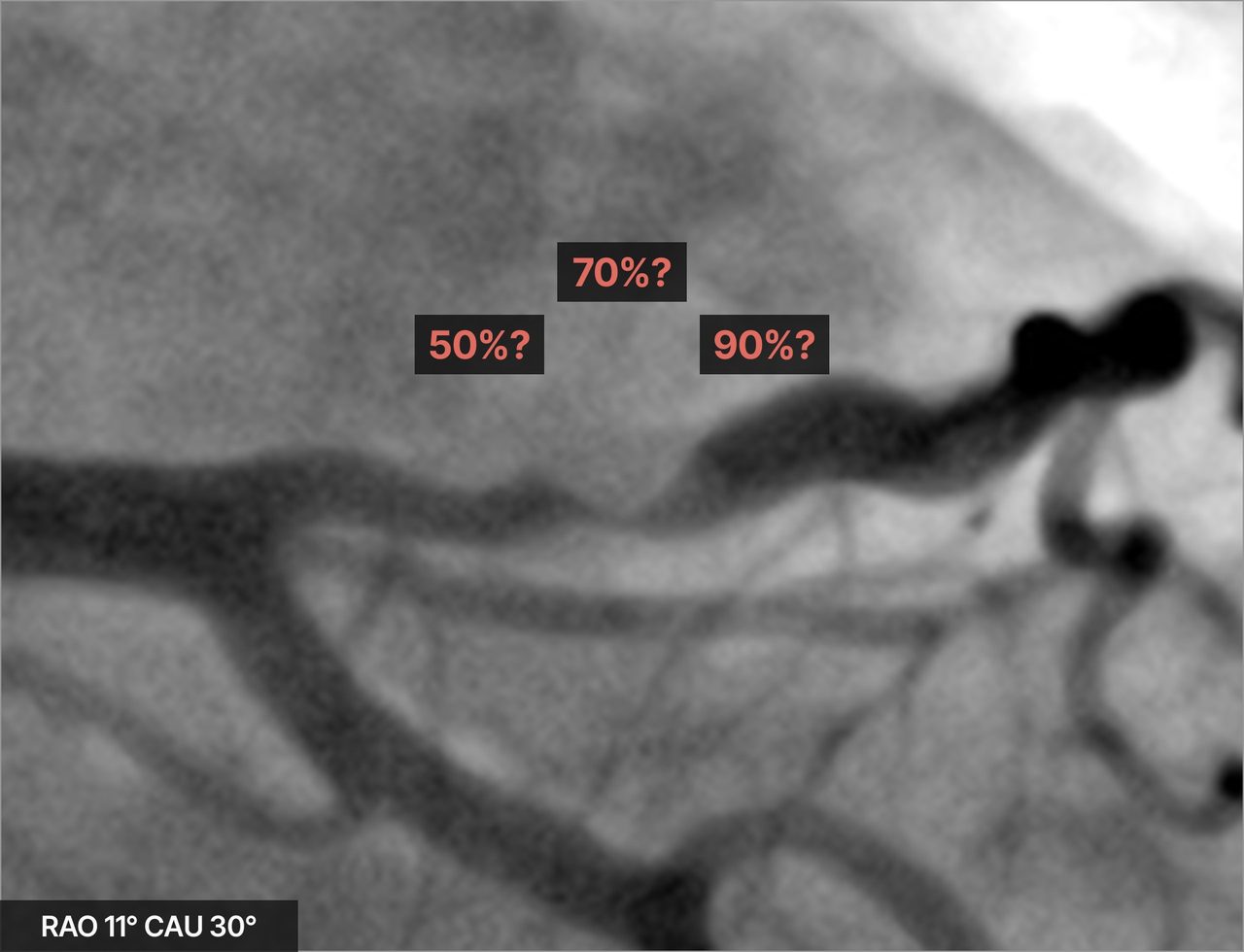
Same film.
Different answers.
The arteries of the heart are filmed as flat X-ray videos and judged by eye. Two doctors can look at the same narrowing and see it differently, and that call decides the treatment.
of calls made from the picture alone disagreed with the pressure measurement, on borderline narrowings.Toth et al., European Heart Journal 2014 (495 cardiologists, 4,421 decisions)
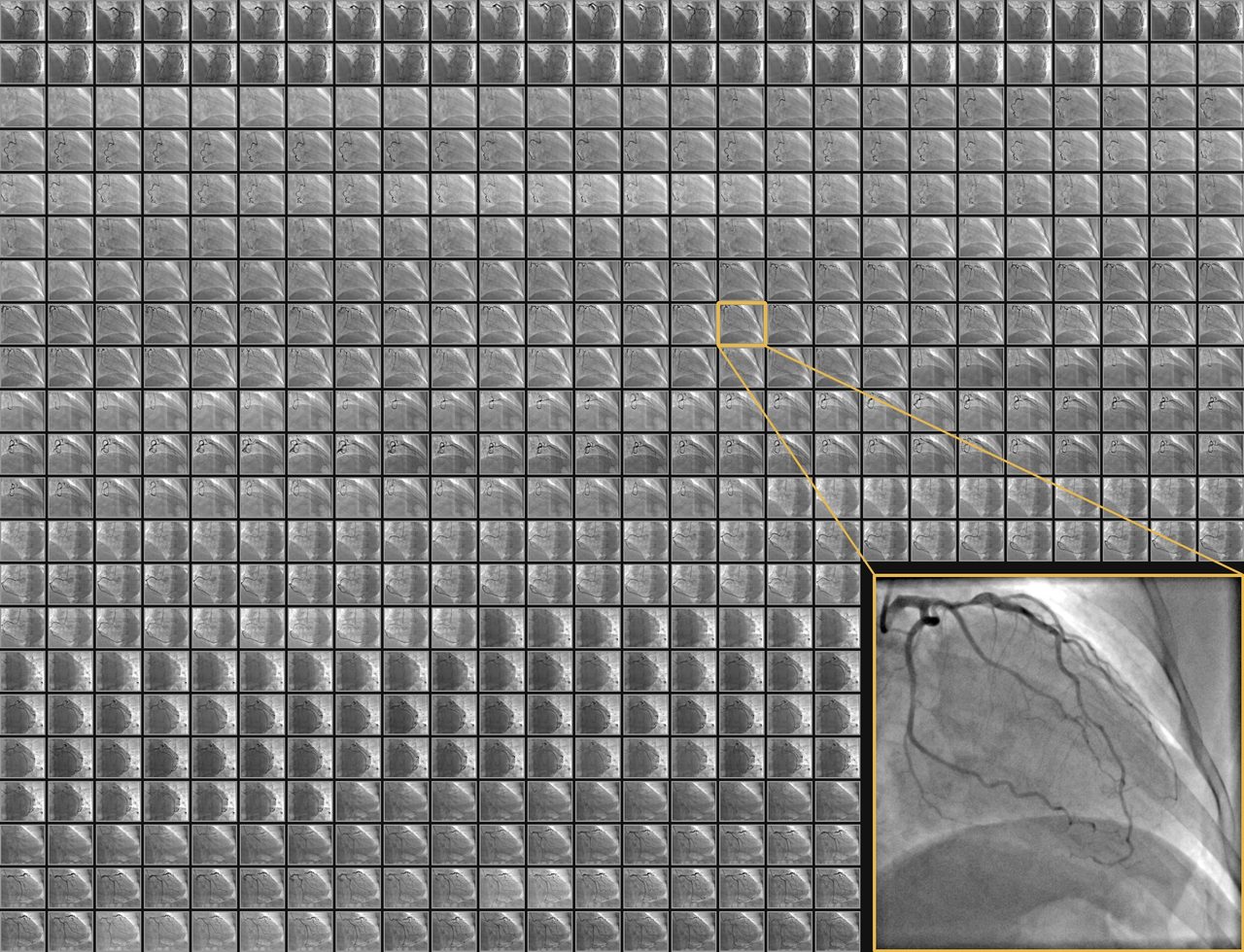
Hundreds of frames.
One pair of eyes.
A heart study is a set of X-ray videos taken from different angles. The doctor watches them one by one.
frames in one study, all watched by eye.CardioTwin count on real studies
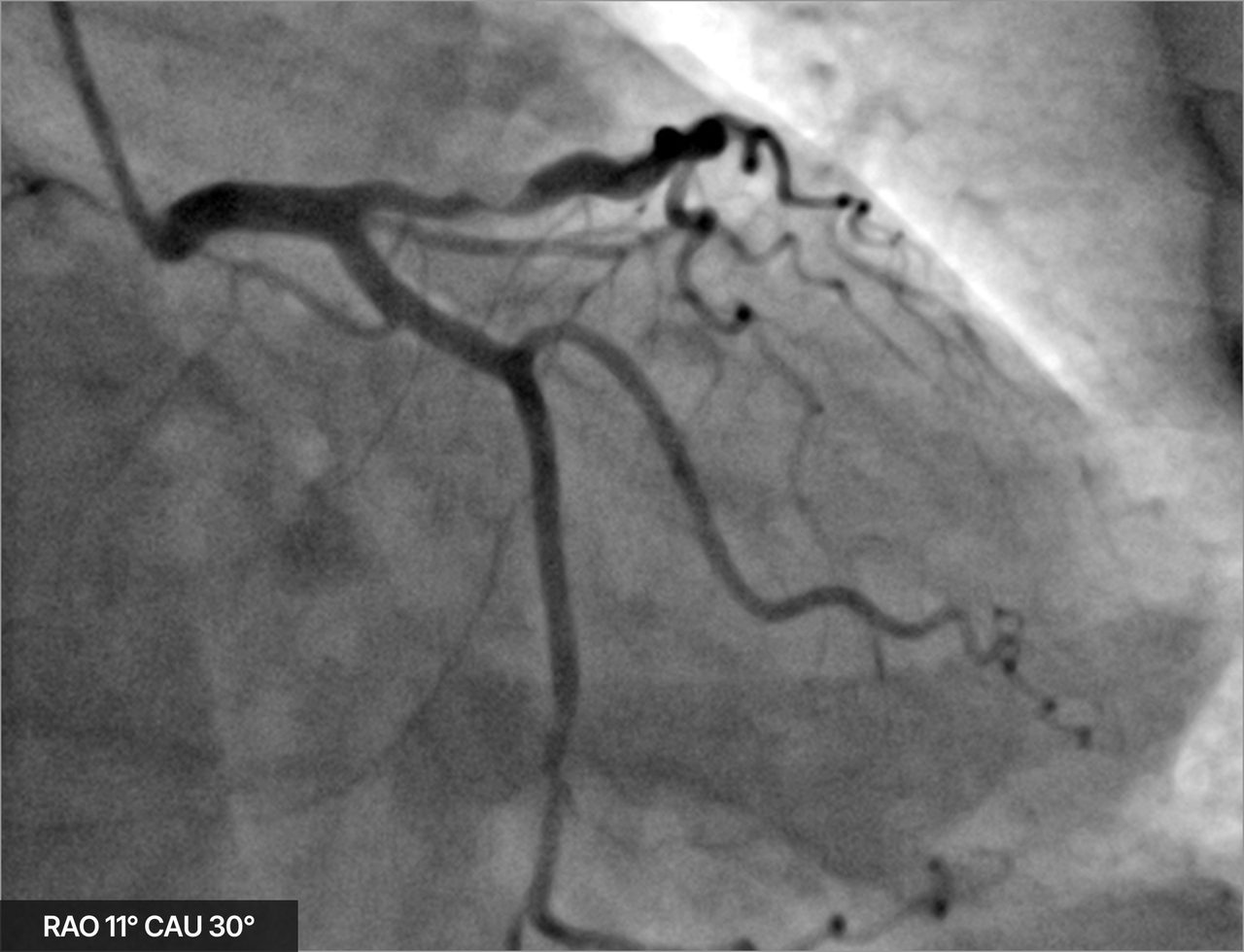
Every artery.
Found by eye.
Nothing on the films is labelled. The doctor goes through every X-ray video to find each artery, name it and spot every narrowing.
X-ray videos in one procedure on average, all searched by eye.Piayda et al., Eur J Med Res 2018 (936 runs in 36 procedures)
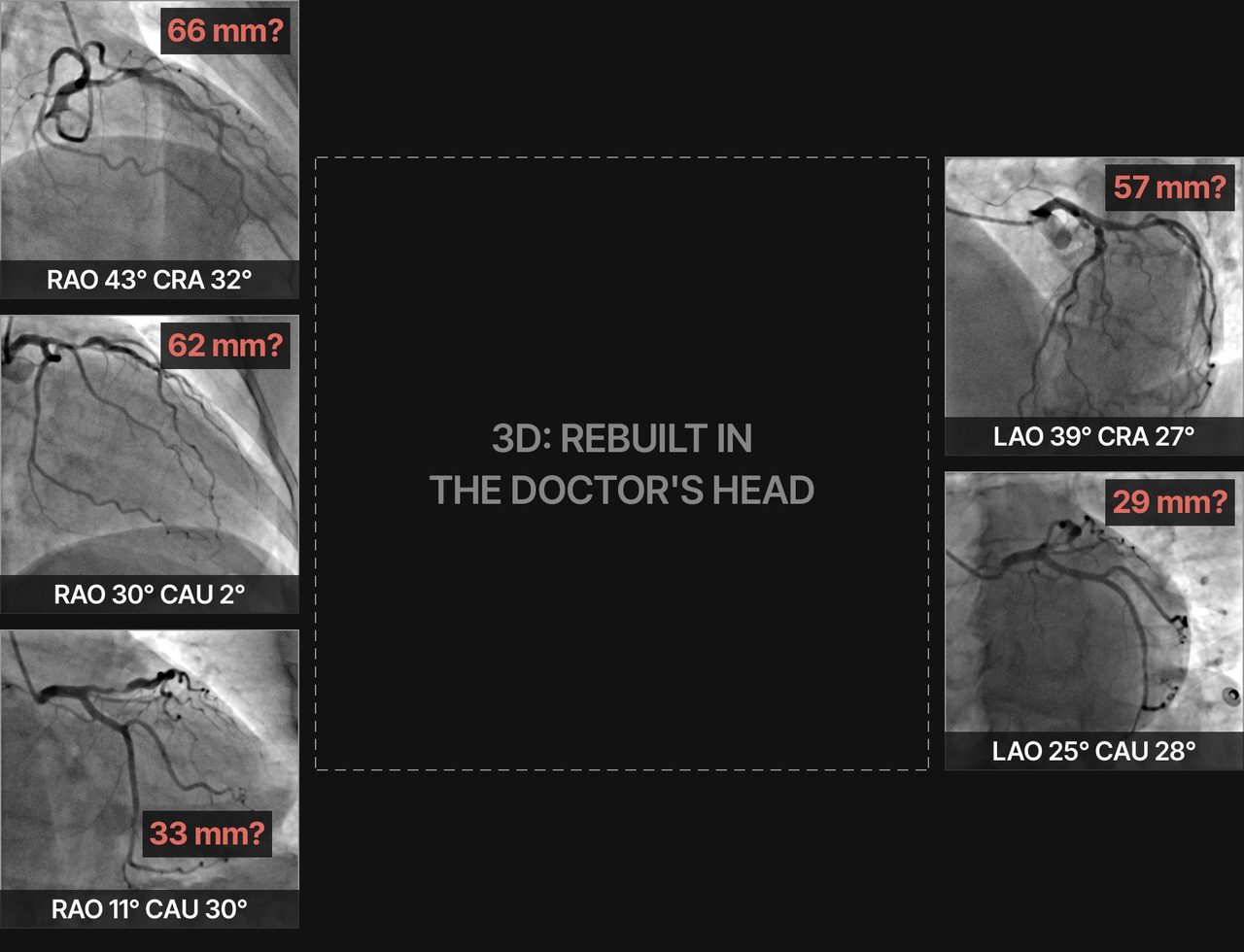
Flat films.
A 3D artery.
Each film is a flat shadow of a curved, moving artery. The doctor puts the 3D picture together in the head, and nothing warns when an angle hides part of it.
of an artery's length can hide in the camera angle chosen by eye.Green et al., Catheter Cardiovasc Interv 2005 (156 stented segments)
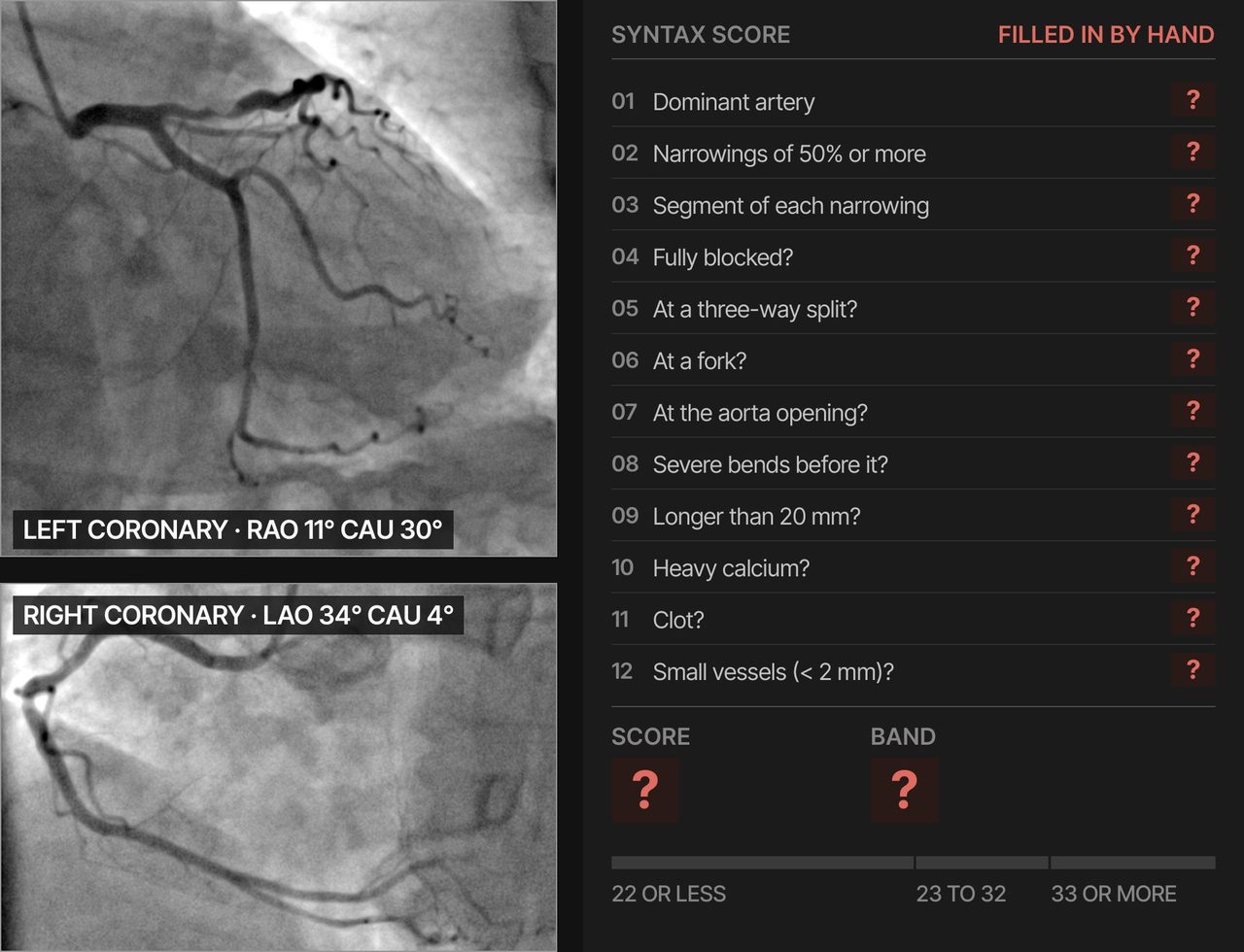
The risk score.
Filled in by hand.
Choosing between a stent and bypass surgery uses a risk score, the SYNTAX score. The doctor answers it question by question, from what they saw on the films.
questions in the SYNTAX score, answered by hand from the films.SYNTAX score algorithm (Sianos et al., EuroIntervention 2005)
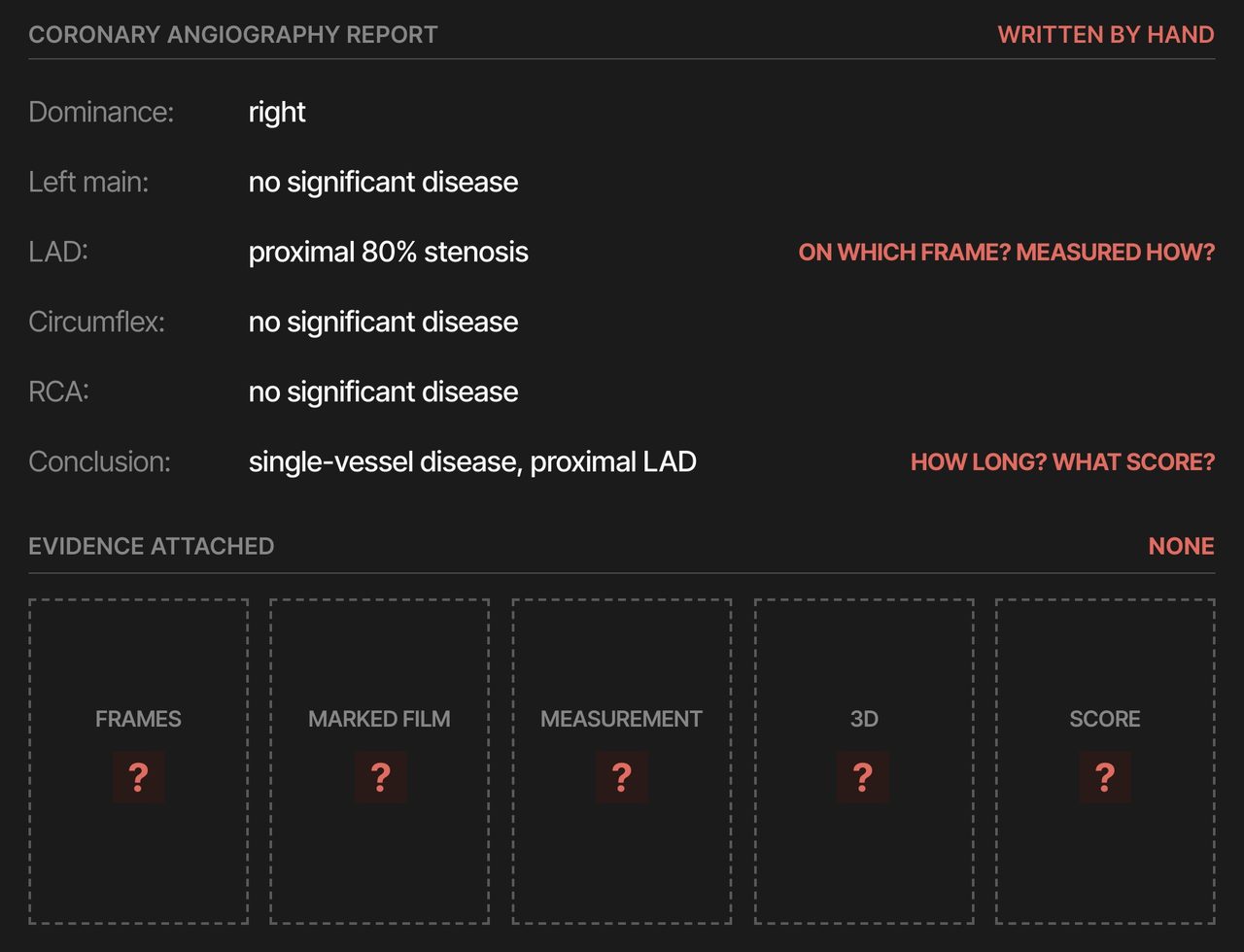
The report says it.
Nothing shows it.
The findings are written up by hand. The report states how tight each narrowing is, with no picture or measurement attached to prove it.
narrowings reported as severe (70% or more) measured below 70% when checked with measurement software.Nallamothu et al., Circulation 2013 (216 lesions, 7 US hospitals)
The solution
One study in. One 3D twin and one report out.
Zero clicks.
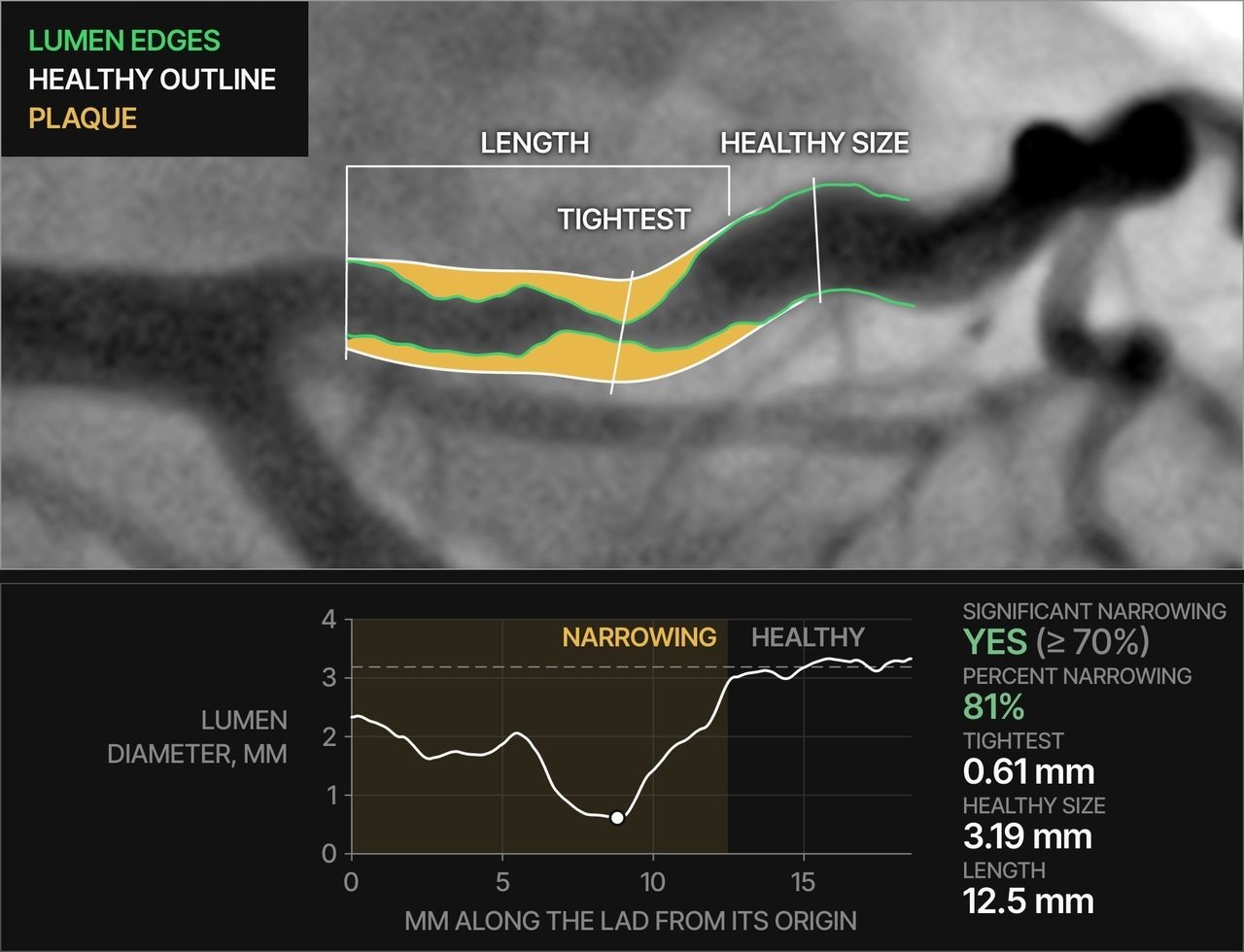
Same film.
One measured answer.
Every narrowing is measured from the artery edges, the same way for every doctor.
not judged by eye.
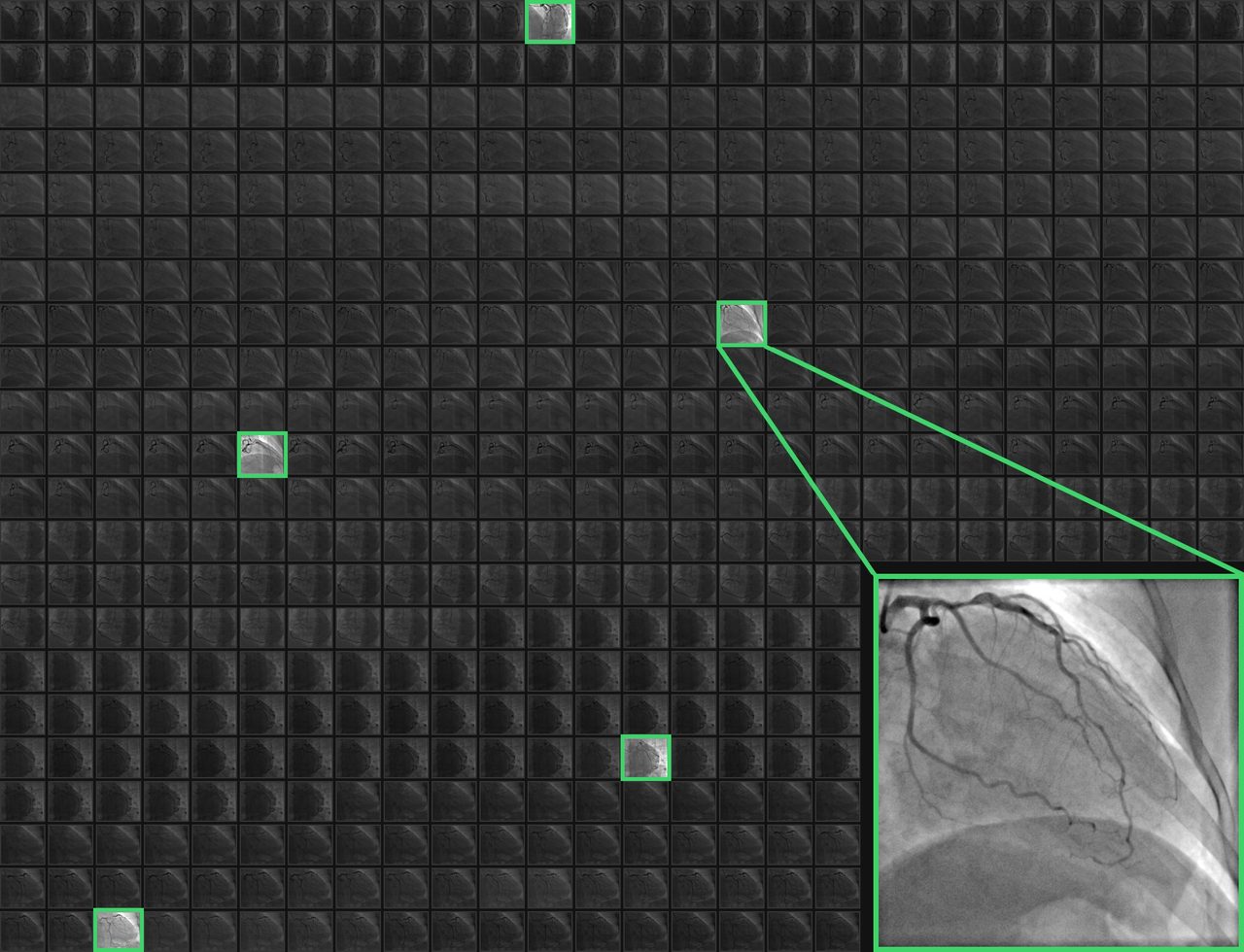
Every frame read.
The best ones picked.
Every frame of every video is read, and the clearest are picked for each artery.
read automatically.
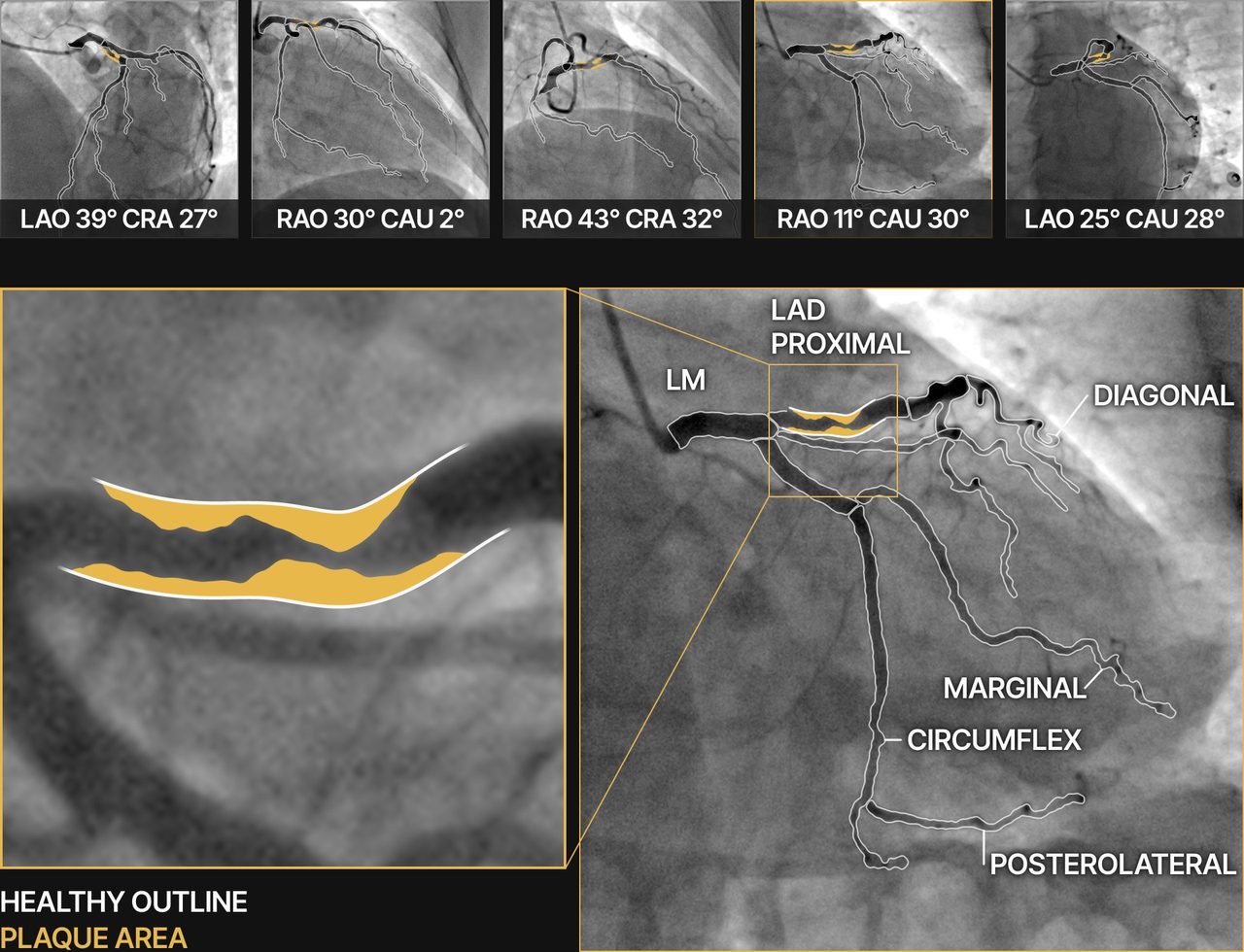
Every artery.
Found and named.
Each artery and each narrowing is found and labelled on the films.
named, every narrowing located.
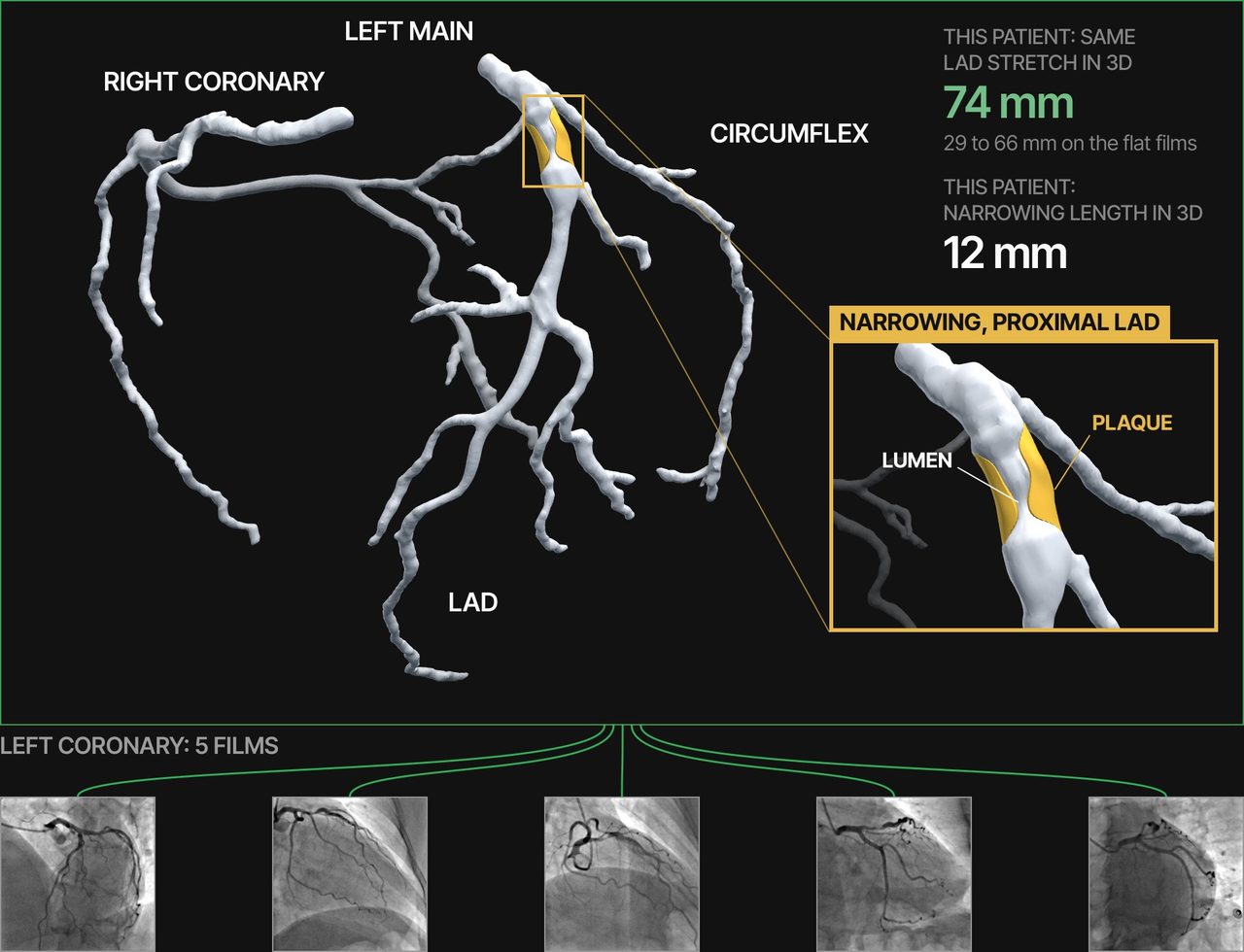
Flat films in.
One 3D twin out.
The arteries are rebuilt in 3D from the films the hospital already takes.
twin from all the films. No new machine.
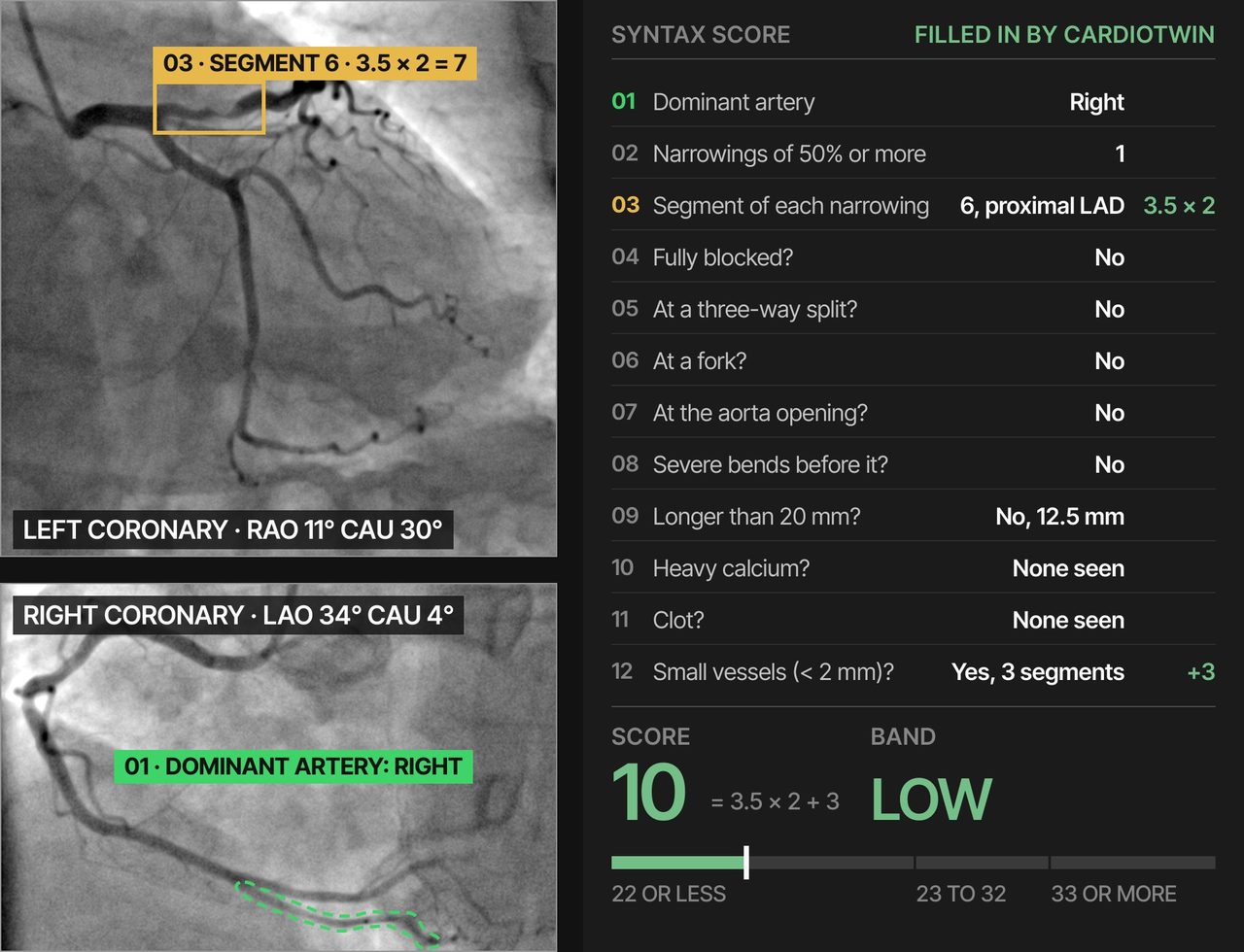
The risk score.
Filled in from the films.
Every SYNTAX question is answered from what was measured.
questions, the same rules on every case.
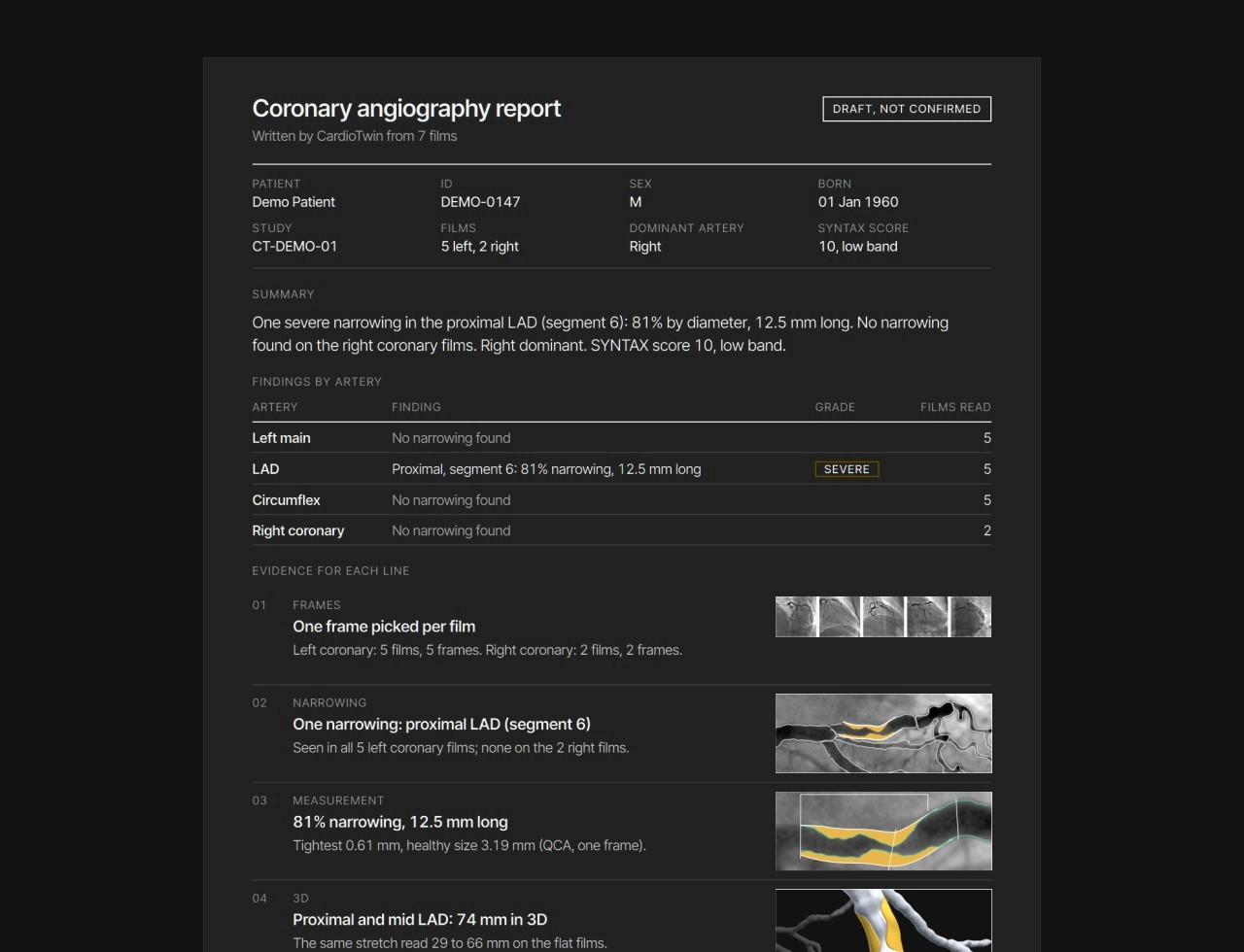
The report.
Every line with its proof.
Each finding comes with its frame, measurement and 3D view. The cardiologist makes the call.
from the films to the report.
Where we are
In research use today.
Clinical use follows clearance.
Research use and hospital pilots
Labs, researchers and hospitals use it on their own films, under research agreements.
File for clearance
Clinical studies with hospitals, then the filings: FDA, CE mark and UKCA.
Clinical use
Starting with the reference sites from the pilots.
Work with us
See it on a real study in a 30-minute demo, then run a research pilot on your own angiograms.
Book a demo ↗Use CardioTwin in your studies under a research licence, before clearance.
Request accessWe are raising our pre-seed round. Ask for the deck and the demo film.
Request the deckGet in touch.
Every message is answered personally by the CardioTwin team.